10 Ways to Make Money with an Internet Radio Station (2026)
How to make money with an internet radio station: ad spots, sponsorships, donations, Patreon, merch, paid air time, affiliates, syndication, and more, with realistic 2026 income examples.
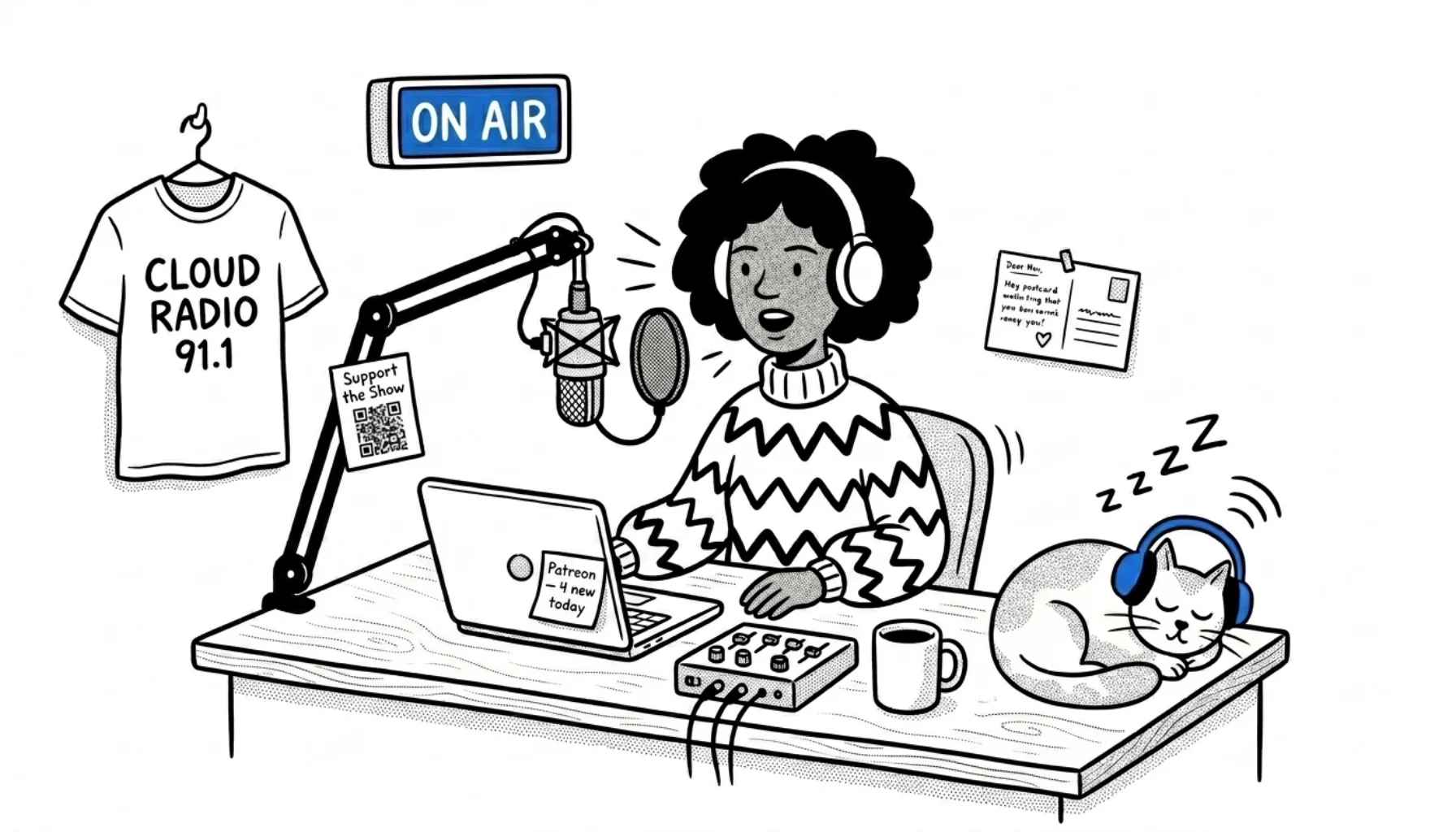
You can make money from an internet radio station, regardless of size. The catch is that small stations have to be smarter about it than big ones. You won't be selling 30-second spots to Coca-Cola at 100 listeners. But you don't need to.
Every active listener is somebody who's chosen your station over Spotify, YouTube, and a thousand podcasts. That attention has value. The trick is knowing how to convert it without alienating the people who give it to you.
Here are ten monetization paths that work for internet radio in 2026, ordered roughly from "easiest at small scale" to "best at large scale." Most stations end up using three or four in combination.
What you'll learn {:#what-youll-learn}
- Donations and tip jars, easiest to set up
- Patreon and paid memberships, most predictable income
- Branded merchandise, works at any size
- Selling air time, overlooked and lucrative
- Direct ad spots
- Sponsorships and underwriting
- Crowdfunding
- Affiliate marketing
- Show syndication
- Consulting and services
- Live events and meetups
- Common questions
1. Donations and tip jars {:#donations}
The lowest-friction option, and the one most underused by small stations. If listeners care about what you do, some of them will pay to keep it going. The trick is making it dead simple to give and being honest about why you're asking.
Add a "Support the Station" button to your website. Link it to PayPal, Stripe, Buy Me a Coffee, or Ko-fi. Buy Me a Coffee is the easiest of the four. It handles one-time donations and recurring memberships in one tool, charges a small platform fee on top of payment processing, and the page builds itself in five minutes. Check their pricing page for the current cut.
Mention it on air, but sparingly. The non-commercial radio model (NPR, community stations like WQXR in New York) is built almost entirely on donations and underwriting. Small stations can pull the same trick at a smaller scale. Even $50/month from listener tips covers a CloudRadio plan and then some.
What works: a sentence on every show ("If you like what we do, the tip jar's at yourstation.com/support"). A one-time bigger ask once a quarter. A public thank-you wall. What doesn't work: badgering listeners every break.
2. Patreon and paid memberships {:#patreon-memberships}
The most predictable monthly revenue you can build. Patreon is free to start and takes a flat 10% platform fee on income (plus payment processing and currency conversion). Memberful, Substack, and Ghost are alternatives if you want to own the audience list and email it directly.
The math is simple: 100 fans paying $5/month is $6,000/year before fees. That's enough to fund a small station outright. The hard part isn't the platform, it's giving members enough that the $5 feels like a steal.
Common membership perks that actually work for radio:
Exclusive content nobody else hears: bonus shows, full-length interview cuts, your DJ's curated monthly playlist sent only to members. Behind-the-scenes access: show notes, equipment breakdowns, "why I picked these tracks" essays. Direct contact: a Discord server for members, a monthly Q&A livestream, the occasional shout-out on air. Early access to new shows or merch drops. Branded swag at higher tiers.
A premium subscriber feed is the cleanest perk for radio. Spin up a second private Icecast/HLS stream (same host, separate mount) that only paying members can access. Bonus shows, full-length interview cuts, ad-free hours, themed sets. Members get a personal stream URL they can paste into any player.
Two practical notes. Don't paywall your main feed. It kills discoverability and audience growth. Keep the live stream free, and tier the extras. Start small. Three tiers (e.g. $3/$10/$25) is plenty. More tiers don't increase signups, they just confuse people.
3. Branded merchandise {:#merchandise}
Print-on-demand killed the merchandise overhead. You don't have to buy 500 t-shirts and ship them yourself anymore.
Printful, Printify, and Spreadshirt all integrate with Shopify, Etsy, or your own website. Upload your station logo, set a price, and they handle production and fulfillment. You pay nothing upfront. Margins are 30–60% per item.
What sells for radio stations: t-shirts (always), hoodies, mugs, stickers (great low-price upsell), tote bags, and enamel pins for collectible drops. What doesn't sell: hats with awkward logos, cheap plastic anything, and merchandise without a story.
The best merch isn't a generic logo on a tee, it's a slogan or in-joke that means something to your audience. The shirts that move are the ones listeners want to wear because their friends won't get the reference.
4. Sell air time {:#sell-air-time}
This is different from selling ad spots, you're selling the content slot itself. A podcaster pays you to broadcast their show on your station. A musician pays for a one-hour DJ set. A local DJ pays to host a weekly show on your stream.
It works because there are far more people who want a microphone than there are stations willing to give them one. You already own the broadcasting infrastructure. Renting it out is pure margin.
Pricing is the question everyone gets stuck on. A practical baseline for niche or local stations with engaged audiences: $10–$30/hour for off-peak slots on a small station, $50–$150/hour for prime time on a station with a real audience. Charge more for evening and weekend prime slots than for graveyard hours.
Two formats work especially well. Pre-recorded shows: the buyer hands you an MP3, you slot it in. Zero work for you on the day. Live remote shows: the buyer streams into your server using an encoder. Set this up once and it's the same effort as your own shows.
5. Sell direct ad spots {:#sell-ad-spots}
The classic radio revenue model still works. It just isn't the place to start.
Direct ads work when you have a targeted audience and a salesperson (you, probably) willing to pitch. A 50-listener station with a hyper-local audience might sell a small monthly sponsor package to a local pizzeria. A 5,000-listener station in a niche genre can sell specialty brands a real ad rotation. The unit you sell matters more than the listener count.
What ad buyers actually want to know: who listens, where they live, when they tune in, and what action they took. If you can't answer those, sell something else first. If you can, our write a radio ad guide walks through the mechanics of producing the spot.
For programmatic ads (the algorithm-served kind), AdsWizz (now part of SiriusXM Media) and Triton Digital plug into your stream and pay per thousand listening hours. Internet radio CPMs are typically modest, often a few dollars per thousand listening hours, but the volume is passive. Worth it for stations large enough that the volume matters.
A simple local sponsor package
For direct local pitches, package the deal so the sponsor sees concrete deliverables:
- 30-second pre-recorded spot in your hourly rotation, X plays per week
- Logo + clickable link on your station page
- One social post per month (Instagram or Facebook)
- Monthly performance report (concurrent listener average, total spot plays, click-throughs)
Bundle this at a flat monthly rate. Most local sponsors find a clear package easier to say yes to than a CPM rate card.
Licensing reminder. Selling ads or sponsorships does not exempt you from music royalties. SoundExchange, ASCAP/BMI/SESAC, and your country's equivalents still apply. See our music licensing guide for the details.
6. Title sponsorship and underwriting {:#sponsorships}
Title sponsorships ("This show is brought to you by...") are easier to land than ad spots because they're cheaper for the sponsor and feel less commercial to listeners.
Pitch a single show or a recurring promo. The sponsor gets their name mentioned at the start and end, plus a logo on the show page. You get a flat monthly fee. Both sides know what they're getting.
For non-commercial stations, this is underwriting: same idea, but the messaging is restricted to facts and value-neutral language (no calls to action, no superlatives). NPR's "support comes from..." reads are the model.
Realistic numbers: $50–$500/month per show depending on audience size. The trick is selling the slot to a business whose customer base overlaps yours. A vintage record store sponsoring a vinyl-themed show is a much easier yes than a generic pitch to a chain.
Make your station look professional
Sponsors and ad buyers ask one question first: "How do I find their station?" If your answer is a free Wix site with a 2018 player on it, you've already lost the deal. CloudRadio One ships a custom-branded HTML5 player, embeddable widgets, a public "now playing" page, and analytics you can show to advertisers, all included.
7. Crowdfunding {:#crowdfunding}
Different from ongoing donations because crowdfunding is goal-based and time-bound: you're raising for a specific project (new equipment, a documentary series, a relaunch) over a fixed window.
Kickstarter is still the largest creative-project platform. It's all-or-nothing, so you only get the money if you hit the goal. Indiegogo has flexible funding (you keep what you raise). Both charge a platform fee plus payment processing. Check their pricing pages for current rates.
Crowdfunding works best when the project has a clear, share-worthy story. "Help us upgrade our studio so we can broadcast in high quality" works. "Pay our hosting bill" doesn't, because hosting bills aren't a story.
Tier rewards drive most of the revenue. Common tiers: $10 for a digital thank-you and a sticker, $50 for a tee and on-air shout-out, $100 for a personal interview slot or a sponsored show segment, $500+ for naming rights or a custom episode.
8. Affiliate marketing {:#affiliate-marketing}
You promote a product, your listeners buy it, you get a cut. Works when your audience trusts your taste and you're recommending things you'd actually use.
The big networks are Amazon Associates (low commissions, huge inventory), Impact, CJ Affiliate, and Awin/ShareASale. Most music gear retailers (Sweetwater, Thomann) have direct affiliate programs with better rates. SaaS tools (recording software, music libraries, hosting platforms) often pay recurring commissions, sometimes for the lifetime of the customer.
The honest version: affiliate revenue compounds slowly. The first year you'll make pennies. Year three, if you have a backlog of show notes and blog posts with affiliate links indexed by Google, it can become a meaningful chunk. The half-life of an affiliate link on a well-trafficked site is years.
What works: linking to specific products in your show notes ("here's the mic I use"), reviewing one piece of gear per episode, and recommending things to a targeted audience. What doesn't: spamming affiliate links into every post.
Disclose your affiliations. In the U.S., the FTC requires "clear and conspicuous" disclosure when you're paid (or earn a commission) for a recommendation. A short on-air mention and a footer line on your blog and show notes is enough. The UK CAP, Canadian Competition Bureau, and EU consumer-protection rules have similar requirements. See the FTC endorsement guides.
9. Syndicate your shows {:#syndication}
If your show is good enough that other stations would broadcast it, license it to them. They get fresh content; you get a fee.
Syndication networks make distribution easier. Westwood One and Premiere Networks sit at the U.S. mainstream tier. Smaller specialty syndicators (e.g. Syndicast in the UK) cover niche genres. Or you can sell directly to stations one at a time.
The path looks like: produce a great show consistently for at least six months, build a marketable demo (highlight reel + audience metrics + scheduling info), pitch program directors. Most won't reply. The ones that do are usually paying $50–$500 per episode for a small syndicated show.
This is a long-tail strategy. The best syndicated shows make their hosts six figures a year. Most never get there. But even a handful of paying stations is meaningful side income for a show you were producing anyway.
For the deeper mechanics see our radio programming guide.
10. Consulting and selling services {:#consulting}
Once you've run a station for a year, you know more than 95% of people trying to start one. That knowledge has value.
Practical paths: writing paid setup guides, selling a Skillshare or Udemy course on starting a radio station, charging for consulting calls (the going rate for niche broadcasting consulting is $50–$200/hour), producing imaging packages for other stations (sweepers, drop-ins, station IDs, sold as Fiverr-style packages).
You can also white-label your operation. Some hosts run small networks of stations under different brand names, all using the same back-end infrastructure. Selling air time at scale to the next person who wants to start their own station, basically, operating an internet radio platform yourself.
Bonus: monetize your website and YouTube {:#bonus-website-youtube}
If you blog or post show clips to YouTube, those have their own monetization paths. Google AdSense and YouTube ad-share both pay variable rates that depend heavily on niche, geography, and viewer behavior. Selling sponsored blog posts directly to advertisers usually pays better than ad networks. Don't anchor a budget on a public RPM benchmark, treat ad-network revenue as a bonus on top of your other paths.
A station blog that ranks for genre-related search terms can pull in passive traffic for years. We've seen small stations earn more from a single well-ranking blog post than from their entire monthly ad inventory.
For ideas on what to write about, see our start a radio show guide and our radio show ideas post.
Bonus: live events and listener meetups {:#live-events}
Once you have a community, the community will pay to gather. Ticketed online listening parties, Q&As with on-air guests, virtual workshops, and small in-person meetups all monetize the relationship without selling anything to listeners. Tools like Streamlabs and Eventbrite make this trivial to set up. A $5–$20 ticket sold to even 50 of your most loyal listeners is a quick $250–$1,000 in the door.
The same approach works for cross-promotion: partner with adjacent podcasters or YouTubers to co-host a livestream, split the proceeds, and trade audiences in the process.
Common questions {:#common-questions}
How many listeners do I need to start making money? Donations and Patreon work at any audience size, even 20 engaged fans can generate $50–$200/month. Direct ad sales typically need 500+ concurrent listeners to be worth the sales effort. Programmatic ads need thousands.
What's the most predictable income path for small stations? Patreon plus tip jar. Both compound with audience size, both work at small scale, both are easy to set up.
Do I need to pay tax on radio income? Yes, in most countries, station income (ads, donations, Patreon, merch) is taxable. Track it from day one. Talk to an accountant.
Can I run ads without paying music royalties? No. Royalties are owed because you're broadcasting copyrighted music, regardless of whether you make money from it. See our music licensing guide.
What's the cheapest hosting plan that lets me monetize? Most hosts (CloudRadio included) don't restrict commercial use. CloudRadio One supports monetized stations out of the box. See the pricing page for plan details.
How long until a station is profitable? Realistically, 6–18 months of consistent broadcasting before any single revenue stream covers hosting costs. Most stations break even at 12 months and turn a small profit at 24 months. See our cost to start a radio station breakdown for the expense side.
Time to take action
Pick one monetization path and set it up this week. Most stations stall because they try to launch ads, Patreon, merch, and syndication all at once and finish none of them. Tip jar first. Patreon next month. Merch the month after. By month six, all three are compounding.
The audience is the asset. Everything else follows from how well you serve them.